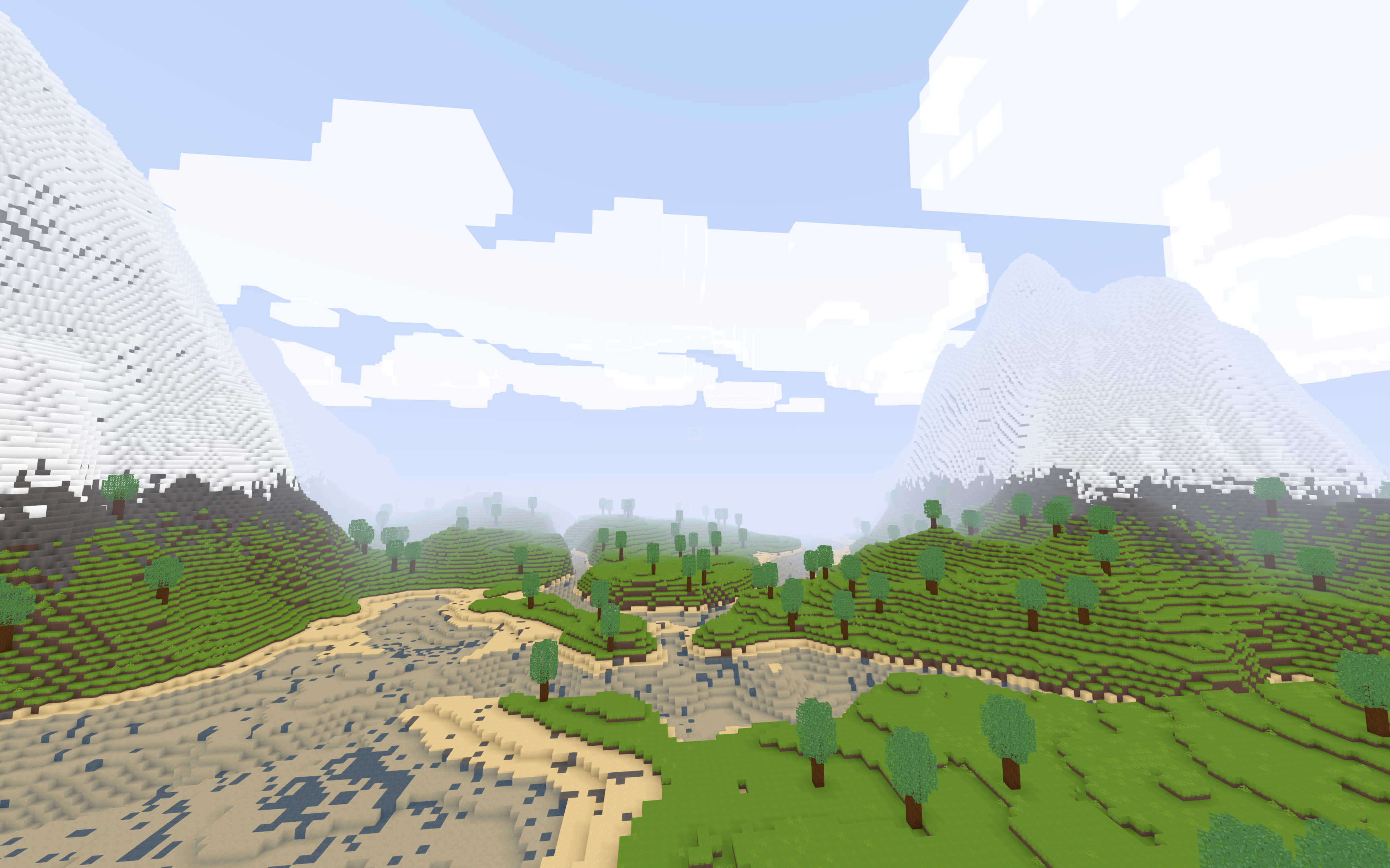
A Voxelize world handles the chunk loading and rendering, as well as any 3D objects.
This class extends the ThreeJS Scene class.
This means that you can add any ThreeJS objects to the world, and they will be rendered. The world
also implements NetIntercept, which means it intercepts chunk-related packets from the server
and constructs chunk meshes from them.
There are a couple components that are by default created by the world that holds data:
- World.registry: A block registry that handles block textures and block instances.
- World.chunks: A chunk manager that stores all the chunks in the world.
- World.physics: A physics engine that handles voxel AABB physics simulation of client-side physics.
- World.loader: An asset loader that handles loading textures and other assets.
- World.sky: A sky that can render the sky and the sun.
- World.clouds: A clouds that renders the cubical clouds.
One thing to keep in mind that there are no specific setters like setVoxelByVoxel or setVoxelRotationByVoxel.
This is because, instead, you should use updateVoxel and updateVoxels to update voxels.
Example
const world = new VOXELIZE.World();

// Update the voxel at `(0, 0, 0)` to a voxel type `12` in the world across the network.
world.updateVoxel(0, 0, 0, 12)

// Register the interceptor with the network.
network.register(world);

// Register an image to block sides.
world.applyBlockTexture("Test", VOXELIZE.ALL_FACES, "https://example.com/test.png");

// Update the world every frame.
world.update(controls.position);
Type parameters
| Name | Type |
|---|---|
T | any |
Hierarchy
-
Scene↳
World
Implements
Constructors
constructor
• new World<T>(options?): World<T>
Create a new Voxelize world.
Type parameters
| Name | Type |
|---|---|
T | any |
Parameters
| Name | Type | Description |
|---|---|---|
options | Partial<WorldOptions> | The options to create the world. |
Returns
World<T>
Overrides
Scene.constructor
Properties
blockAnimations
• blockAnimations: BlockAnimations
How animated blocks (Block.isAnimated: doors, and whatever else moves
between its states) swing from one state's geometry into the next. The
game registers a BlockAnimation per block name; the engine
tracks each such voxel's mesh across remeshes and drives the motion.
blockTextureGeneration
• blockTextureGeneration: number = 0
How many times a block texture has been written, bumped by every texture API. Every atlas slot starts life as the magenta-and-black unknown checker, and painting is spread over the load (image loads resolve whenever they resolve), so anything that samples the atlas into its own table has to be able to tell that its table predates the paint. Compare this against the value read when the table was built; unequal means rebuild.
chunkPipeline
• chunkPipeline: ChunkPipeline
Pipeline for chunk lifecycle state machine (request -> processing -> loaded).
chunkRenderer
• chunkRenderer: ChunkRenderer
Chunk rendering state (materials, uniforms).
clouds
• clouds: Clouds
The clouds that renders the cubical clouds.
csmRenderer
• csmRenderer: CSMRenderer = null
The CSM (Cascaded Shadow Map) renderer for shader-based lighting.
extraInitData
• extraInitData: Record<string, unknown> = {}
farTerrain
• farTerrain: FarTerrain
Coarse terrain past the loaded chunks, drawn from server-sampled tiles
when the world serves them (farTerrain in the INIT options) and
farTerrainDistance is above 0. See FarTerrain.
isInitialized
• isInitialized: boolean = false
Whether or not this world is connected to the server and initialized with data from the server.
items
• items: ItemRegistry
The item registry that holds all item definitions and provides utility methods for item operations.
lightCones
• lightCones: LightCones
Shared dynamic spot-cone lighting (flashlights, vehicle headlights). The game rebuilds the cone list every frame; chunk materials bind these uniforms at creation.
loader
• loader: Loader
An asset loader to load in things like textures, images, GIFs and audio buffers.
localLights
• localLights: LocalLights
Local light emitters: block-anchored sources scanned out of chunks plus game-registered dynamic sources, clustered into the chunk shaders. The game declares semantic block profiles and dynamic lights; the engine owns scanning, selection, culling, and GPU representation.
meshApplyStats
• meshApplyStats: MeshApplyStats
Running cost of applying mesh results on the main thread; see MeshApplyStats.
meshPipeline
• meshPipeline: MeshPipeline
Pipeline for mesh generation with ordering guarantees.
meshTransfer
• Readonly meshTransfer: Object
Configure and inspect mesh worker buffer transfer (transfer vs SharedArrayBuffer).
Type declaration
| Name | Type |
|---|---|
benchmark | (options: MeshTransferBenchmarkOptions) => Promise<MeshTransferBenchmarkResult> |
configure | (config: { mode?: WorkerTransferMode }) => void |
getMode | () => WorkerTransferMode |
getStats | () => MeshWorkerTransferStats | Record<WorkerTransferStrategy, MeshWorkerTransferStats> |
getStatus | () => { isCrossOriginIsolated: boolean ; isSharedArrayBufferAvailable: boolean ; mode: WorkerTransferMode ; pool: ChunkSharedPoolStats ; stats: MeshWorkerTransferStats | Record<WorkerTransferStrategy, MeshWorkerTransferStats> ; strategy: WorkerTransferStrategy } |
getStrategy | () => WorkerTransferStrategy |
isSharedArrayBufferAvailable | () => boolean |
resetStats | () => void |
setStrategy | (strategy: "transfer" | "shared") => void |
options
• options: WorldOptions
The options to create the world.
orderIndependent
• orderIndependent: OrderIndependentTransparency = null
The blended layers' accumulation, when
WorldClientOptions.orderIndependentTransparency is set; null
draws the sorted pipeline.
physics
• physics: Engine
The voxel physics engine using @voxelize/physics-engine.
regionArenas
• regionArenas: ChunkRegionArenas = null
Region buffer arenas batching the shared-opaque bucket, one
BatchedMesh per region; null until the first opaque section lands or
when WorldClientOptions.regionArenas disables batching.
registry
• registry: Registry
The block registry that holds all block data, such as texture and block properties.
shaderClock
• Readonly shaderClock: ShaderClock
The clock chunk shaders animate on (waves, sway, flicker, animated atlas frames): the shared clock, slewed and wrapped for the GPU, so every player sees the same wave at the same moment.
sky
• sky: Sky
The sky that renders the sky and the sun.
swayProfileTable
• Readonly swayProfileTable: Uniform<any>
Flat vec4-pair table behind the shared cutout buckets' sway shader; see createSwayTableShader. Slot 0 stays zeroed as the "no sway" profile.
waterOptics
• waterOptics: WaterOptics
The camera-driven underwater optics state, updated via World.updateWaterOptics.
waterOpticsFluidFilter
• waterOpticsFluidFilter: (block: Block) => boolean = null
Which fluid blocks count as water for the camera's underwater optics.
null (the default) treats every fluid as water. A game with other
fluids (lava) returns false for them, so a camera inside one does not
get water fog, sky fade and the backside water surface.
Type declaration
▸ (block): boolean
Parameters
| Name | Type |
|---|---|
block | Block |
Returns
boolean
Accessors
day
• get day(): number
Days the world clock has completed. With World.time it forms World.sharedClock; on its own it is what a moon phase or a "day N" readout would count.
Returns
number
deleteRadius
• get deleteRadius(): number
Returns
number
disposed
• get disposed(): boolean
Whether dispose has run. A disposed world is a corpse: its workers are gone and its chunks released, and anything still holding it is holding the whole scene graph in memory for nothing.
Returns
boolean
farTerrainDistance
• get farTerrainDistance(): number
How far the far-terrain layer reaches past the viewer, in blocks; 0
turns it off. Takes effect only in a world that serves far terrain.
The fog range follows it. See WorldOptions.farTerrainDistance.
Returns
number
• set farTerrainDistance(distance): void
Parameters
| Name | Type |
|---|---|
distance | number |
Returns
void
fogDistance
• get fogDistance(): number
A fixed fog distance in blocks, independent of renderRadius; null
when fog is still derived from the radius. See
WorldOptions.fogDistance.
Returns
number
• set fogDistance(distance): void
Parameters
| Name | Type |
|---|---|
distance | number |
Returns
void
renderRadius
• get renderRadius(): number
Returns
number
• set renderRadius(radius): void
Parameters
| Name | Type |
|---|---|
radius | number |
Returns
void
sectionVisibilityStats
• get sectionVisibilityStats(): Object
Returns
Object
| Name | Type |
|---|---|
constrained | number |
isComplete | boolean |
reached | number |
sections | number |
visible | number |
sharedClock
• get sharedClock(): number
Seconds since the world's clock began: day * timePerDay + time. Unlike
World.time it never wraps at midnight, and every client of a
world agrees on it to within the STATS sync threshold, which makes it
the clock for cosmetic motion all players must see alike — cloud drift,
the shooting-star schedule. A /time jump moves it within the current
day, so those effects jump with the sky rather than diverging from it.
A world whose clock is frozen (doesTickTime false) has no shared game
clock at all, so the wall clock stands in: clients agree to within their
NTP skew, which is all a cosmetic schedule needs.
Returns
number
time
• get time(): number
Returns
number
• set time(time): void
Parameters
| Name | Type |
|---|---|
time | number |
Returns
void
Methods
addBlockEntityUpdateListener
▸ addBlockEntityUpdateListener(listener): () => void
Parameters
| Name | Type |
|---|---|
listener | BlockEntityUpdateListener<T> |
Returns
fn
▸ (): void
Returns
void
addBlockUpdateListener
▸ addBlockUpdateListener(listener): () => void
Parameters
| Name | Type |
|---|---|
listener | BlockUpdateListener |
Returns
fn
▸ (): void
Returns
void
addChunkInitListener
▸ addChunkInitListener(coords, listener): () => void
Parameters
| Name | Type |
|---|---|
coords | Coords2 |
listener | (chunk: Chunk) => void |
Returns
fn
▸ (): void
Returns
void
adoptOrderIndependentMaterials
▸ adoptOrderIndependentMaterials(materials): Material[]
Adopts every material in materials that can accumulate, and makes the
texel forks of the see-through chunk materials among them, so a warmup
compiles the programs play draws with (a material adopted after it
compiled compiles again). Returns the forks: no scene holds them until
a mesh's textures call for one, so a warmup has to draw them itself.
Parameters
| Name | Type |
|---|---|
materials | Iterable<Material, any, any> |
Returns
Material[]
applyBlockFrames
▸ applyBlockFrames(idOrName, faceNames, keyframes, fadeFrames?): Promise<void>
Apply a set of keyframes to a block. This will load the keyframes from the sources and start the animation to play the keyframes on the block's texture atlas.
Parameters
| Name | Type | Default value | Description |
|---|---|---|---|
idOrName | string | number | undefined | The ID or name of the block. |
faceNames | string | string[] | undefined | The face name or names to apply the texture to. |
keyframes | [number, string | Color | HTMLImageElement][] | undefined | The keyframes to apply to the texture. |
fadeFrames | number | 0 | The number of frames to fade between each keyframe. |
Returns
Promise<void>
applyBlockGif
▸ applyBlockGif(idOrName, faceNames, source, interval?): Promise<void>
Apply a GIF animation to a block. This will load the GIF from the source and start the animation using applyBlockFrames internally.
Parameters
| Name | Type | Default value | Description |
|---|---|---|---|
idOrName | string | undefined | The ID or name of the block. |
faceNames | string | string[] | undefined | The face name or names to apply the texture to. |
source | string | undefined | The source of the GIF. Note that this must be a GIF file ending with .gif. |
interval | number | 66.666667 | The interval between each frame of the GIF in milliseconds. Defaults to 66.666667ms. |
Returns
Promise<void>
applyBlockTexture
▸ applyBlockTexture(idOrName, faceNames, source): void
Apply a texture to a face or faces of a block. This will automatically load the image from the source and draw it onto the block's texture atlas.
An isolated face, whose pixels belong to a voxel, takes this as its default — what the face looks like where there is no voxel to ask, which is every display mesh: a held block, a drop, an inventory thumbnail. applyBlockTextureAt still overrides it per voxel.
Parameters
| Name | Type | Description |
|---|---|---|
idOrName | string | number | The ID or name of the block. |
faceNames | string | string[] | The face names to apply the texture to. |
source | string | Color | Texture<unknown> | HTMLImageElement | The source of the texture. |
Returns
void
Deprecated
When applying the same texture to multiple faces, use texture groups instead for better atlas efficiency. Define texture_group on the server-side block faces and use applyTextureGroup or applyTextureGroups on the client.
applyBlockTextureAt
▸ applyBlockTextureAt(idOrName, faceName, source, voxel): CustomChunkShaderMaterial
Parameters
| Name | Type |
|---|---|
idOrName | string | number |
faceName | string |
source | string | Color | Texture<unknown> | HTMLImageElement |
voxel | Coords3 |
Returns
applyBlockTextures
▸ applyBlockTextures(data): Promise<void[]>
Apply multiple block textures at once. See applyBlockTexture for more information.
Parameters
| Name | Type | Description |
|---|---|---|
data | { faceNames: string | string[] ; idOrName: string | number ; source: string | Color }[] | The data to apply the block textures. |
Returns
Promise<void[]>
A promise that resolves when all the textures are applied.
Deprecated
When applying the same texture to multiple faces, use texture groups instead for better atlas efficiency. Define texture_group on the server-side block faces and use applyTextureGroup or applyTextureGroups on the client.
applyTextureGroup
▸ applyTextureGroup(groupName, source): any
Parameters
| Name | Type |
|---|---|
groupName | string |
source | string | Color | Texture<unknown> | HTMLImageElement |
Returns
any
applyTextureGroups
▸ applyTextureGroups(data): Promise<any[]>
Parameters
| Name | Type |
|---|---|
data | { groupName: string ; source: string | Color | Texture<unknown> | HTMLImageElement }[] |
Returns
Promise<any[]>
benchmarkMeshTransfer
▸ benchmarkMeshTransfer(options): Promise<MeshTransferBenchmarkResult>
Parameters
| Name | Type |
|---|---|
options | MeshTransferBenchmarkOptions |
Returns
Promise<MeshTransferBenchmarkResult>
customizeBlockDynamic
▸ customizeBlockDynamic(idOrName, fn): void
Parameters
| Name | Type |
|---|---|
idOrName | string | number |
fn | (pos: Coords3) => { aabbs: AABB[] ; faces: { corners: { pos: [number, number, number] ; uv: number[] }[] ; dir: [number, number, number] ; emissive?: number ; independent: boolean ; isolated: boolean ; name: string ; pigmentMask?: number ; range: UV ; regionalTint?: boolean ; stageTintMask?: number ; textureGroup: string }[] ; isTransparent: [boolean, boolean, boolean, boolean, boolean, boolean] } |
Returns
void
customizeMaterialShaders
▸ customizeMaterialShaders(idOrName, faceName?, data?): CustomChunkShaderMaterial
Parameters
| Name | Type | Default value |
|---|---|---|
idOrName | string | number | undefined |
faceName | string | null |
data | Object | undefined |
data.fragmentShader | string | undefined |
data.uniforms? | Object | undefined |
data.vertexShader | string | undefined |
Returns
dispose
▸ dispose(): void
Returns
void
expandCoupledUpdates
▸ expandCoupledUpdates(updates): BlockUpdate[]
Expand a batch of updates so every coupled unit it touches changes
whole — the mirror of the server's update intake, run on every batch
updateVoxels receives. Exposed so a caller can learn the outcome of a
placement before committing to it (an anchor whose partner voxel is
occupied expands to nothing); the result is idempotent, so it can be
handed straight back to World.updateVoxels. See
expandCoupledUpdates.
Parameters
| Name | Type |
|---|---|
updates | BlockUpdate[] |
Returns
fillUnpaintedSurfaces
▸ fillUnpaintedSurfaces(options?): TextureFillResult
Dress every surface still on the unknown checker: an isolated face in
its default if that has landed, everything else in
options.unpaintedFallbackColor. The census keeps reporting them as
fallback, so a stage made presentable this way does not pass for a
finished one.
Parameters
| Name | Type |
|---|---|
options | Object |
options.color? | string |
Returns
floodLight
▸ floodLight(queue, color, min?, max?): void
Propagate light nodes outward through the loaded chunks. The algorithm itself lives in "./lighting" and senses the world through the VoxelLightVolume slice this class satisfies.
Parameters
| Name | Type |
|---|---|
queue | LightNode[] |
color | LightColor |
min? | Coords3 |
max? | Coords3 |
Returns
void
getAABBOverride
▸ getAABBOverride(voxel): AABB[]
Parameters
| Name | Type |
|---|---|
voxel | Coords3 |
Returns
AABB[]
getAABBOverrideOwner
▸ getAABBOverrideOwner(voxel): Coords3
The block voxel an override cell answers for, when it has one.
Parameters
| Name | Type |
|---|---|
voxel | Coords3 |
Returns
getBarrierTopAt
▸ getBarrierTopAt(vx, vy, vz): number
World-space height the server's bodies find the voxel at vx, vy, vz
standing to (its block's barrierHeight above the voxel's floor), or
-Infinity where its block has no barrier or no chunk is loaded. The
client's own body collides with getCollisionAABBsAt alone; the
physics engine reads this so automatic moves never carry it over.
Parameters
| Name | Type |
|---|---|
vx | number |
vy | number |
vz | number |
Returns
number
getBaseFogRange
▸ getBaseFogRange(): WorldFogRange
Returns
getBlockAABBsAt
▸ getBlockAABBsAt(vx, vy, vz): AABB[]
Parameters
| Name | Type |
|---|---|
vx | number |
vy | number |
vz | number |
Returns
AABB[]
getBlockAABBsByIdAt
▸ getBlockAABBsByIdAt(id, vx, vy, vz): AABB[]
Parameters
| Name | Type |
|---|---|
id | number |
vx | number |
vy | number |
vz | number |
Returns
AABB[]
getBlockAABBsForDynamicPatterns
▸ getBlockAABBsForDynamicPatterns(vx, vy, vz, dynamicPatterns): { aabb: AABB ; worldSpace: boolean }[]
Parameters
| Name | Type |
|---|---|
vx | number |
vy | number |
vz | number |
dynamicPatterns | BlockDynamicPattern[] |
Returns
{ aabb: AABB ; worldSpace: boolean }[]
getBlockAt
▸ getBlockAt(px, py, pz): Block
Get the block type data by a 3D world position.
Parameters
| Name | Type | Description |
|---|---|---|
px | number | The x coordinate of the position. |
py | number | The y coordinate of the position. |
pz | number | The z coordinate of the position. |
Returns
The block at the given position, or null if it does not exist.
getBlockById
▸ getBlockById(id): Block
Get the block type data by a block id. Unknown ids resolve to air (logged once per id) so a server/client registry gap can never take down meshing, lighting, or the agent bridge.
Parameters
| Name | Type | Description |
|---|---|---|
id | number | The block id. |
Returns
The block data for the given id, or air if it is unknown.
getBlockByIdSafe
▸ getBlockByIdSafe(id): Block
Parameters
| Name | Type |
|---|---|
id | number |
Returns
getBlockByName
▸ getBlockByName(name): Block
Get the block type data by a block name.
Parameters
| Name | Type | Description |
|---|---|---|
name | string | The block name. |
Returns
The block data for the given name, or null if it does not exist.
getBlockEntityDataAt
▸ getBlockEntityDataAt(px, py, pz): T
Parameters
| Name | Type |
|---|---|
px | number |
py | number |
pz | number |
Returns
T
getBlockEntityIdAt
▸ getBlockEntityIdAt(px, py, pz): string
Parameters
| Name | Type |
|---|---|
px | number |
py | number |
pz | number |
Returns
string
getBlockFaceMaterial
▸ getBlockFaceMaterial(idOrName, faceName?, voxel?): CustomChunkShaderMaterial
Parameters
| Name | Type |
|---|---|
idOrName | string | number |
faceName? | string |
voxel? | Coords3 |
Returns
getBlockFacesByFaceNames
▸ getBlockFacesByFaceNames(id, faceNames, warnUnknown?): { corners: { pos: [number, number, number] ; uv: number[] }[] ; dir: [number, number, number] ; emissive?: number ; independent: boolean ; isolated: boolean ; name: string ; pigmentMask?: number ; range: UV ; regionalTint?: boolean ; stageTintMask?: number ; textureGroup: string }[]
Parameters
| Name | Type | Default value |
|---|---|---|
id | number | undefined |
faceNames | string | RegExp | string[] | undefined |
warnUnknown | boolean | false |
Returns
{ corners: { pos: [number, number, number] ; uv: number[] }[] ; dir: [number, number, number] ; emissive?: number ; independent: boolean ; isolated: boolean ; name: string ; pigmentMask?: number ; range: UV ; regionalTint?: boolean ; stageTintMask?: number ; textureGroup: string }[]
getBlockFacesForDynamicPatterns
▸ getBlockFacesForDynamicPatterns(blockId, dynamicPatterns): { corners: { pos: [number, number, number] ; uv: number[] }[] ; dir: [number, number, number] ; emissive?: number ; independent: boolean ; isolated: boolean ; name: string ; pigmentMask?: number ; range: UV ; regionalTint?: boolean ; stageTintMask?: number ; textureGroup: string }[]
Parameters
| Name | Type |
|---|---|
blockId | number |
dynamicPatterns | BlockDynamicPattern[] |
Returns
{ corners: { pos: [number, number, number] ; uv: number[] }[] ; dir: [number, number, number] ; emissive?: number ; independent: boolean ; isolated: boolean ; name: string ; pigmentMask?: number ; range: UV ; regionalTint?: boolean ; stageTintMask?: number ; textureGroup: string }[]
getBlockOf
▸ getBlockOf(idOrName): Block
Parameters
| Name | Type |
|---|---|
idOrName | string | number |
Returns
getBlockPassableForDynamicPatterns
▸ getBlockPassableForDynamicPatterns(vx, vy, vz, dynamicPatterns, defaultPassable): boolean
Parameters
| Name | Type |
|---|---|
vx | number |
vy | number |
vz | number |
dynamicPatterns | BlockDynamicPattern[] |
defaultPassable | boolean |
Returns
boolean
getBranchAABBsAt
▸ getBranchAABBsAt(block, vx, vy, vz): AABB[]
The boxes the branch voxel of block at vx, vy, vz is drawn and
collides as, in blocks of the voxel: a one-voxel branch or fin's core
and arms, or a wide section cell's slice of its core's tube (see
branch.ts). Empty for a block that is not a branch, a cut core and a
shell whose core is gone.
Parameters
| Name | Type |
|---|---|
block | Block |
vx | number |
vy | number |
vz | number |
Returns
AABB[]
getChunkByCoords
▸ getChunkByCoords(cx, cz): Chunk
Get a chunk by its 2D coordinates.
Parameters
| Name | Type | Description |
|---|---|---|
cx | number | The x coordinate of the chunk. |
cz | number | The z coordinate of the chunk. |
Returns
The chunk at the given coordinates, or undefined if it does not exist.
getChunkByName
▸ getChunkByName(name): Chunk
Get a chunk by its name.
Parameters
| Name | Type | Description |
|---|---|---|
name | string | The name of the chunk to get. |
Returns
The chunk with the given name, or undefined if it does not exist.
getChunkByPosition
▸ getChunkByPosition(px, py, pz): Chunk
Get a chunk that contains a given position.
Parameters
| Name | Type | Description |
|---|---|---|
px | number | The x coordinate of the position. |
py | number | The y coordinate of the position. |
pz | number | The z coordinate of the position. |
Returns
The chunk that contains the position at the given position, or undefined if it does not exist.
getChunkStatus
▸ getChunkStatus(cx, cz): "requested" | "processing" | "loaded" | "to request"
Get the status of a chunk.
Parameters
| Name | Type | Description |
|---|---|---|
cx | number | The x 2D coordinate of the chunk. |
cz | number | The z 2D coordinate of the chunk. |
Returns
"requested" | "processing" | "loaded" | "to request"
The status of the chunk.
getCollisionAABBsAt
▸ getCollisionAABBsAt(vx, vy, vz): AABB[]
The boxes a rigid body collides with in the voxel at vx, vy, vz, in
world space: exactly what the physics engine stands bodies on. Empty
where no chunk is loaded, and for passable blocks and fluids.
Parameters
| Name | Type |
|---|---|
vx | number |
vy | number |
vz | number |
Returns
AABB[]
getIsolatedBlockMaterialAt
▸ getIsolatedBlockMaterialAt(voxel, faceName, defaultDimension?): CustomChunkShaderMaterial
Parameters
| Name | Type |
|---|---|
voxel | Coords3 |
faceName | string |
defaultDimension? | number |
Returns
getLightColorAt
▸ getLightColorAt(vx, vy, vz): Color
Get a color instance that represents what an object would be like if it were rendered at the given 3D voxel coordinate. This is useful to dynamically shade objects based on their position in the world. Also used in LightShined.
Parameters
| Name | Type | Description |
|---|---|---|
vx | number | The voxel's X position. |
vy | number | The voxel's Y position. |
vz | number | The voxel's Z position. |
Returns
Color
The voxel's light color at the given coordinate.
getLightValuesAt
▸ getLightValuesAt(vx, vy, vz): Object
Parameters
| Name | Type |
|---|---|
vx | number |
vy | number |
vz | number |
Returns
Object
| Name | Type |
|---|---|
blue | number |
green | number |
red | number |
sunlight | number |
getMaxHeightAt
▸ getMaxHeightAt(px, pz): number
Get the highest block at a x/z position. Highest block means the first block counting downwards that
isn't empty (isEmpty).
Parameters
| Name | Type | Description |
|---|---|---|
px | number | The x coordinate of the position. |
pz | number | The z coordinate of the position. |
Returns
number
The highest block at the given position, or 0 if it does not exist.
getMemoryCounters
▸ getMemoryCounters(): WorldMemoryCounters
Live sizes of every queue and in-flight set in the voxel update -> relight -> remesh pipeline, plus the bytes of serialized chunk payloads parked in worker queues. This is the memory-pressure dashboard for debugging update-flood OOMs (mass terrain edits): sample it while carving and watch which stage balloons.
Returns
getPreviousValueAt
▸ getPreviousValueAt(px, py, pz, count?): number
Get the previous value of a voxel by a 3D world position.
Parameters
| Name | Type | Default value | Description |
|---|---|---|---|
px | number | undefined | The x coordinate of the position. |
py | number | undefined | The y coordinate of the position. |
pz | number | undefined | The z coordinate of the position. |
count | number | 1 | By how much to look back in the history. Defaults to 1. |
Returns
number
getRawVoxelAt
▸ getRawVoxelAt(px, py, pz): number
The whole packed voxel word at a 3D world position — id, rotation,
stage and waterlogging together — or 0 where no chunk is loaded. For
callers that compare voxel states as a unit; getVoxelAt and its
siblings unpack one field each.
Parameters
| Name | Type |
|---|---|
px | number |
py | number |
pz | number |
Returns
number
getSunlightAt
▸ getSunlightAt(px, py, pz): number
Get a voxel sunlight by a 3D world position.
Parameters
| Name | Type | Description |
|---|---|---|
px | number | The x coordinate of the position. |
py | number | The y coordinate of the position. |
pz | number | The z coordinate of the position. |
Returns
number
The voxel sunlight at the given position, or 0 if it does not exist.
getTextureInfo
▸ getTextureInfo(): Object
Returns
Object
| Name | Type |
|---|---|
sharedAtlas | { canvas: HTMLCanvasElement ; countPerSide: number } |
sharedAtlas.canvas | HTMLCanvasElement |
sharedAtlas.countPerSide | number |
textures | TextureInfo[] |
getTorchLightAt
▸ getTorchLightAt(px, py, pz, color): number
Get a voxel torch light by a 3D world position.
Parameters
| Name | Type | Description |
|---|---|---|
px | number | The x coordinate of the position. |
py | number | The y coordinate of the position. |
pz | number | The z coordinate of the position. |
color | LightColor | The color of the torch light. |
Returns
number
The voxel torchlight at the given position, or 0 if it does not exist.
getVoxelAt
▸ getVoxelAt(px, py, pz): number
Get a voxel by a 3D world position.
Parameters
| Name | Type | Description |
|---|---|---|
px | number | The x coordinate of the position. |
py | number | The y coordinate of the position. |
pz | number | The z coordinate of the position. |
Returns
number
The voxel at the given position, or 0 if it does not exist.
getVoxelRotationAt
▸ getVoxelRotationAt(px, py, pz): BlockRotation
Get a voxel rotation by a 3D world position.
Parameters
| Name | Type | Description |
|---|---|---|
px | number | The x coordinate of the position. |
py | number | The y coordinate of the position. |
pz | number | The z coordinate of the position. |
Returns
The voxel rotation at the given position, or the default rotation if it does not exist.
getVoxelStageAt
▸ getVoxelStageAt(px, py, pz): number
Get a voxel stage by a 3D world position.
Parameters
| Name | Type | Description |
|---|---|---|
px | number | The x coordinate of the position. |
py | number | The y coordinate of the position. |
pz | number | The z coordinate of the position. |
Returns
number
The voxel stage at the given position, or 0 if it does not exist.
getVoxelWaterlogLevelAt
▸ getVoxelWaterlogLevelAt(px, py, pz): number
The level of waterlogging fluid held by the voxel at a 3D world position.
Parameters
| Name | Type | Description |
|---|---|---|
px | number | The x coordinate of the position. |
py | number | The y coordinate of the position. |
pz | number | The z coordinate of the position. |
Returns
number
getVoxelWaterloggedAt
▸ getVoxelWaterloggedAt(px, py, pz): boolean
Whether the voxel at a 3D world position holds the world's waterlogging fluid alongside its block.
Parameters
| Name | Type | Description |
|---|---|---|
px | number | The x coordinate of the position. |
py | number | The y coordinate of the position. |
pz | number | The z coordinate of the position. |
Returns
boolean
hasCustomBlockMaterial
▸ hasCustomBlockMaterial(id): boolean
Parameters
| Name | Type |
|---|---|
id | number |
Returns
boolean
initialize
▸ initialize(): Promise<void>
Initialize the world with the data received from the server. This includes populating the registry, setting the options, and creating the texture atlas.
Returns
Promise<void>
isCameraSubmerged
▸ isCameraSubmerged(): boolean
Whether the camera is under water, by the same smoothed submersion the
water shaders read: which side of the water a see-through layer in the
camera's medium draws on (TRANSPARENT_SORT).
Returns
boolean
isChunkInView
▸ isChunkInView(center, target, direction, threshold): boolean
Parameters
| Name | Type |
|---|---|
center | Coords2 |
target | Coords2 |
direction | Vector3 |
threshold | number |
Returns
boolean
isFluidOrWaterloggedAt
▸ isFluidOrWaterloggedAt(vx, vy, vz): boolean
Whether the voxel at a world position holds water: either it is a fluid block or a block waterlogged with the world's fluid. Reads the packed voxel word once off the chunk instead of resolving the chunk twice (once for the waterlogging bit, once for the block).
Parameters
| Name | Type |
|---|---|
vx | number |
vy | number |
vz | number |
Returns
boolean
isWithinWorld
▸ isWithinWorld(cx, cz): boolean
Whether or not if this chunk coordinate is within (inclusive) the world's bounds. That is, if this chunk coordinate is within WorldServerOptions.minChunk and WorldServerOptions.maxChunk.
Parameters
| Name | Type | Description |
|---|---|---|
cx | number | The chunk's X position. |
cz | number | The chunk's Z position. |
Returns
boolean
Whether or not this chunk is within the bounds of the world.
makeBlockMesh
▸ makeBlockMesh(idOrName, options?): Group<Object3DEventMap>
Get a mesh of the model of the given block.
Parameters
| Name | Type | Description |
|---|---|---|
idOrName | string | number | - |
options | Partial<{ cached: boolean ; centered: boolean ; crumbs: boolean ; material: "basic" | "standard" ; separateFaces: boolean }> | The options of creating this block mesh. |
Returns
Group<Object3DEventMap>
A 3D mesh (group) of the block model.
measureWaterColumnAt
▸ measureWaterColumnAt(x, y, z): WaterColumnSample
The water column standing over a point — its depth below the resting
surface and where that surface sits — or null when the point is not
in water. See measureWaterColumn for the walk itself.
A column is one (x, z), so it lives in exactly one chunk: the chunk
resolves once and every block of the walk is a raw read off it. The
per-block getBlockAt walk this replaces paid a chunk name lookup and
a registry lookup for every block between the point and the surface,
so a fish forty blocks down cost forty of each, several times a second.
Parameters
| Name | Type |
|---|---|
x | number |
y | number |
z | number |
Returns
meshChunkLocally
▸ meshChunkLocally(cx, cz, level, generation?, isPriority?): Promise<void>
Parameters
| Name | Type | Default value |
|---|---|---|
cx | number | undefined |
cz | number | undefined |
level | number | undefined |
generation? | number | undefined |
isPriority | boolean | false |
Returns
Promise<void>
meshVoxelBox
▸ meshVoxelBox(box): Promise<VoxelBoxMesh>
Parameters
| Name | Type |
|---|---|
box | VoxelBoxInput |
Returns
Promise<VoxelBoxMesh>
off
▸ off<K>(event, listener): this
Unregister a typed event listener for chunk lifecycle events.
Type parameters
| Name | Type |
|---|---|
K | extends keyof WorldChunkEvents |
Parameters
| Name | Type | Description |
|---|---|---|
event | K | The event name to stop listening to. |
listener | WorldChunkEvents[K] | The callback function to remove. |
Returns
this
The world instance for chaining.
on
▸ on<K>(event, listener): this
Register a typed event listener for chunk lifecycle events.
Type parameters
| Name | Type |
|---|---|
K | extends keyof WorldChunkEvents |
Parameters
| Name | Type | Description |
|---|---|---|
event | K | The event name to listen to. |
listener | WorldChunkEvents[K] | The callback function to execute when the event is emitted. |
Returns
this
The world instance for chaining.
onContextRestored
▸ onContextRestored(): void
GPU context restored: every chunk atlas already mirrors its animated
patches onto its own backing canvas as they draw (AtlasTexture. commitAnimationPatch), so re-uploading it is just needsUpdate = true
on the texture three.js already holds — nothing to rebuild from
scratch. Local lights pack their own GPU-resident grids and shadow
atlas outside three's texture pipeline, so they get their own hook.
Wire this to the canvas's webglcontextrestored event (after calling
preventDefault() in a webglcontextlost listener — without it the
browser never attempts to restore the context at all).
Returns
void
onDispose
▸ onDispose(callback): () => void
Tie a resource to this world's lifetime: callback runs once when the
world is disposed (at once, if it already has been). For timers, DOM
listeners and other things that close over the world from outside the
scene graph -- a texture repainted on an interval, a subscription -- and
would otherwise outlive it. A page that mounts a second world (a
hot-reload remount) keeps every such closure of the first alive, and the
world behind it, until the tab is reloaded.
Parameters
| Name | Type |
|---|---|
callback | () => void |
Returns
fn
A function that unregisters the callback.
▸ (): void
Returns
void
once
▸ once<K>(event, listener): this
Register a one-time typed event listener for chunk lifecycle events.
Type parameters
| Name | Type |
|---|---|
K | extends keyof WorldChunkEvents |
Parameters
| Name | Type | Description |
|---|---|---|
event | K | The event name to listen to once. |
listener | WorldChunkEvents[K] | The callback function to execute when the event is emitted. |
Returns
this
The world instance for chaining.
orderIndependentBandOf
▸ orderIndependentBandOf(object, material): number
See TransparentMediumSource.orderIndependentBandOf.
Parameters
| Name | Type |
|---|---|
object | Object3D<Object3DEventMap> |
material | Material |
Returns
number
prepareTransparency
▸ prepareTransparency(renderer, camera): void
Call once a frame with the camera the scene is about to render with,
before that render. Drawing order-independently, it draws the depth of
the water in view (the surface the blended layers are split at, see
OrderIndependentSeparator), arms the accumulation for that camera,
and re-plans the see-through meshes when a block texture was written
since (a texture can gain or lose its translucent texels). Sorted, it
draws the depth of the water near the panes in view (WaterDepthPass);
a frame without it draws every pane before the water.
Parameters
| Name | Type |
|---|---|
renderer | WebGLRenderer |
camera | Camera |
Returns
void
raycastVoxels
▸ raycastVoxels(origin, direction, maxDistance, options?): Object
Raycast through the world of voxels and return the details of the first block intersection.
Parameters
| Name | Type | Description |
|---|---|---|
origin | Coords3 | The origin of the ray. |
direction | Coords3 | The direction of the ray. |
maxDistance | number | The maximum distance of the ray. |
options | Object | The options for the ray. |
options.ignoreFluids? | boolean | Whether or not to ignore fluids. Defaults to true. |
options.ignoreList? | number[] | A list of blocks to ignore. Defaults to []. |
options.ignorePassables? | boolean | Whether or not to ignore passable blocks. Defaults to false. |
options.ignoreSeeThrough? | boolean | Whether or not to ignore see through blocks. Defaults to false. |
Returns
Object
| Name | Type |
|---|---|
normal | number[] |
point | number[] |
voxel | number[] |
removeAABBOverride
▸ removeAABBOverride(voxel): void
Parameters
| Name | Type |
|---|---|
voxel | Coords3 |
Returns
void
removeLight
▸ removeLight(voxel, color): void
Parameters
| Name | Type |
|---|---|
voxel | Coords3 |
color | LightColor |
Returns
void
removeLightsBatch
▸ removeLightsBatch(voxels, color): void
Batch remove light from multiple voxels that previously emitted the same light color. This drastically improves performance when many contiguous light sources are removed at once.
Parameters
| Name | Type |
|---|---|
voxels | Coords3[] |
color | LightColor |
Returns
void
renderShadowMaps
▸ renderShadowMaps(renderer, entities?, instancePools?): void
Parameters
| Name | Type |
|---|---|
renderer | WebGLRenderer |
entities? | Object3D<Object3DEventMap>[] |
instancePools? | Group<Object3DEventMap>[] |
Returns
void
setAABBOverride
▸ setAABBOverride(voxel, aabbs, owner?): void
Parameters
| Name | Type |
|---|---|
voxel | Coords3 |
aabbs | AABB[] |
owner? | Coords3 |
Returns
void
setBlockEntityDataAt
▸ setBlockEntityDataAt(px, py, pz, data, options?): void
Parameters
| Name | Type |
|---|---|
px | number |
py | number |
pz | number |
data | T |
options? | Object |
options.replace? | boolean |
Returns
void
setBlockSway
▸ setBlockSway(idOrName, options?): void
Register a sway profile for a cutout block instead of compiling it a
bespoke material: the block stays in its shared cutout bucket and its
quads carry the profile's index into the table
createSwayTableShader reads. Parameter defaults mirror
createSwayShader; isCrossShaded selects the flattened
cross-quad shading the dedicated cross materials used to bake in.
Parameters
| Name | Type |
|---|---|
idOrName | string | number |
options | Partial<{ amplitude: number ; isCrossShaded: boolean ; rooted: boolean ; scale: number ; speed: number ; yScale: number }> |
Returns
void
setBlockTextureFiltering
▸ setBlockTextureFiltering(mode): void
Flips how every chunk atlas samples at glancing angles, live: no world
rebuild, no chunk remesh, just the texture's filter/mip state (see
AtlasTexture.applyFiltering, WorldOptions.blockTextureFiltering).
Meant for an A/B run — flip it, hold a pose, measure, flip it back.
Parameters
| Name | Type |
|---|---|
mode | "nearest" | "mip-aniso" |
Returns
void
setResolutionOf
▸ setResolutionOf(idOrName, faceNames, resolution): Promise<void>
Apply a resolution to a block. This will set the resolution of the block's texture atlas. Keep in mind that this face or faces must be independent.
Parameters
| Name | Type | Description |
|---|---|---|
idOrName | string | number | The ID or name of the block. |
faceNames | string | string[] | The face name or names to apply the resolution to. |
resolution | number | { x: number ; y: number } | The resolution to apply to the block, in pixels. |
Returns
Promise<void>
setSectionReveal
▸ setSectionReveal(cx, cz, level, reveal): boolean
Draw a section partway through its own fog color: 0 is pure fog tint
(the sky-dome gradient it would vanish into at distance), 1 is the
section as itself. The terrain fade-in drives this per frame.
Reaches both render paths of a section. Its shared-opaque geometry lives
in a region arena slot, whose per-instance batching color carries the
value into vChunkReveal; everything else is a per-section mesh on a
shared material, which gets the value through a per-draw uChunkReveal
that is reset after each draw so the same material draws every other
chunk unrevealed. Returns whether the section had anything to draw.
Parameters
| Name | Type |
|---|---|
cx | number |
cz | number |
level | number |
reveal | number |
Returns
boolean
setShowGreedyDebug
▸ setShowGreedyDebug(show): void
Parameters
| Name | Type |
|---|---|
show | boolean |
Returns
void
setSunlightAt
▸ setSunlightAt(px, py, pz, level): void
Parameters
| Name | Type |
|---|---|
px | number |
py | number |
pz | number |
level | number |
Returns
void
setTorchLightAt
▸ setTorchLightAt(px, py, pz, level, color): void
Parameters
| Name | Type |
|---|---|
px | number |
py | number |
pz | number |
level | number |
color | LightColor |
Returns
void
setVoxelAt
▸ setVoxelAt(px, py, pz, voxel): void
Parameters
| Name | Type |
|---|---|
px | number |
py | number |
pz | number |
voxel | number |
Returns
void
setVoxelRotationAt
▸ setVoxelRotationAt(px, py, pz, rotation): void
Set a voxel rotation at a 3D world position.
Parameters
| Name | Type | Description |
|---|---|---|
px | number | The x coordinate of the position. |
py | number | The y coordinate of the position. |
pz | number | The z coordinate of the position. |
rotation | BlockRotation | The rotation to set. |
Returns
void
setVoxelStageAt
▸ setVoxelStageAt(px, py, pz, stage): void
Parameters
| Name | Type |
|---|---|
px | number |
py | number |
pz | number |
stage | number |
Returns
void
setVoxelWaterlogLevelAt
▸ setVoxelWaterlogLevelAt(px, py, pz, level): void
Parameters
| Name | Type |
|---|---|
px | number |
py | number |
pz | number |
level | number |
Returns
void
setVoxelWaterloggedAt
▸ setVoxelWaterloggedAt(px, py, pz, isWaterlogged): void
Parameters
| Name | Type |
|---|---|
px | number |
py | number |
pz | number |
isWaterlogged | boolean |
Returns
void
textureCensus
▸ textureCensus(): TextureCensus
What every block surface is wearing right now: atlas slots, own-texture face defaults, and every voxel's isolated face, with the ones not yet in their own art listed worst first. The harness asserts on this after a load; a human would otherwise be hunting the scene for magenta.
Returns
transparentMediumAt
▸ transparentMediumAt(x, y, z): TransparentMedium
The medium at a world position, for TRANSPARENT_SORT.
Parameters
| Name | Type |
|---|---|
x | number |
y | number |
z | number |
Returns
update
▸ update(position?, direction?, camera?, isSpectating?): void
Parameters
| Name | Type | Default value |
|---|---|---|
position | Vector3 | undefined |
direction | Vector3 | undefined |
camera? | Camera | undefined |
isSpectating | boolean | false |
Returns
void
updateShaderLighting
▸ updateShaderLighting(camera, position): void
Parameters
| Name | Type |
|---|---|
camera | Camera |
position | Vector3 |
Returns
void
updateSkyAndClouds
▸ updateSkyAndClouds(position): void
Parameters
| Name | Type |
|---|---|
position | Vector3 |
Returns
void
updateVoxel
▸ updateVoxel(vx, vy, vz, type, options): void
This sends a block update to the server and updates across the network. Block updates are queued to World.chunks | World.chunks.toUpdate and scaffolded to the server WorldClientOptions.maxUpdatesPerUpdate times per tick. Keep in mind that for rotation and y-rotation, the value should be one of the following:
- Rotation: PX_ROTATION | NX_ROTATION | PY_ROTATION | NY_ROTATION | PZ_ROTATION | NZ_ROTATION
- Y-rotation: 0 to Y_ROT_SEGMENTS - 1.
This ignores blocks that are not defined, and also ignores rotations for blocks that are not Block.rotatable (Same for if block is not Block.yRotatable).
Parameters
| Name | Type | Description |
|---|---|---|
vx | number | The voxel's X position. |
vy | number | The voxel's Y position. |
vz | number | The voxel's Z position. |
type | number | The type of the voxel. |
options | Object | The options for the voxel. |
options.rotation? | number | The major axis rotation of the voxel. |
options.source? | "client" | "server" | Whether the update is from the client or server. Defaults to "client". |
options.stage? | number | The stage of the voxel. |
options.yRotation? | number | The Y rotation on the major axis. Applies to blocks with major axis of PY or NY. |
Returns
void
updateVoxels
▸ updateVoxels(updates, source?): void
Parameters
| Name | Type | Default value |
|---|---|---|
updates | BlockUpdate[] | undefined |
source | "client" | "server" | "client" |
Returns
void
updateWaterOptics
▸ updateWaterOptics(cameraPosition, deltaSeconds): void
Parameters
| Name | Type |
|---|---|
cameraPosition | Vector3 |
deltaSeconds | number |
Returns
void